
Seven Northwestern Employees Earn Doctoral Degrees
December 18, 2025
ALVA, Okla. — Seven Northwestern Oklahoma State University employees earned their doctoral degrees this past year.
They are: Melissa Brown, graduate studies enrollment and retention coordinator; Summer Foster, early childhood education program coordinator and instructor of education; Bailey Lancaster, assistant professor of psychology; Christopher Neu, instructor of psychology; Heidi Ritchie, assistant professor nursing; Derek Trabuc, instructor of education; and Olivia Yandel, director of the J.R. Holder Wellness Center.
Dr. Melissa Brown
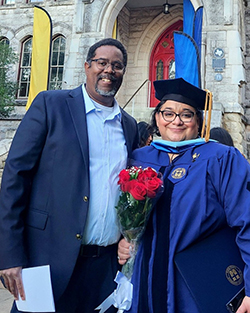
Dr. Melissa Brown (right) and her husband Dr. Roger Brown (left) take a photo at the St. Edward’s University graduation ceremony in Austin, Texas, on Dec. 12.
Brown graduated with her Doctor of Education in Leadership and Higher Education from St. Edward’s University in Austin, Texas, on Dec. 12.
She is a Northwestern alumna, graduating with her Bachelor of Arts in History in 2017 and her Master of Education in Adult Education and Management in 2019.
“My degree and research contribute to Northwestern's success by supporting my current role as graduate enrollment and retention coordinator. This role ensures that our graduate students receive the necessary support to achieve their goals.”
Her dissertation is titled, “‘Why We Stay, Why We Leave’: Women’s Voices in the M.Ed. Journey of Motivation and Persistence,” examining the barriers to completion and motivational factors influencing persistence among women enrolled in the Master of Education program at a public regional university in the South-Central United States.
Findings revealed that participants frequently encountered challenges in balancing full-time employment, family obligations and financial pressures. Despite these barriers, intrinsic motivation, opportunities for professional advancement and strong support networks from family, peers and faculty were key factors promoting persistence and program completion.
The study’s findings confirm the applicability of Vincent Tinto’s theoretical framework to graduate education, highlighting that social and academic integration are crucial for student retention. Results underscore the importance of institutional efforts to enhance financial support, foster faculty engagement, and provide flexible program structures that accommodate nontraditional students.
“I am deeply grateful for the support I received at Northwestern, which has shaped my academic journey,” Brown said. “I will continue to serve the university in various capacities, as well as conduct research in leadership, higher education, and retention.”
Dr. Summer Foster
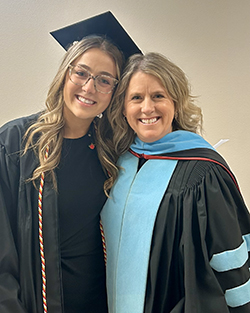
Dr. Summer Foster (right) celebrates with her daughter Mary Kate Foster (left). Dr. Foster graduated with a Doctor of Education in Education Administration and Leadership from Southern Nazarene University on Dec. 6, and Mary Kate graduated with a Bachelor of Science in Education from Northwestern Oklahoma State University on Dec. 7.
Foster graduated with her Doctor of Education in Education Administration and Leadership from Southern Nazarene University on Dec. 6.
She also holds a Bachelor of Science in Elementary Education with an emphasis on Speech Language Pathology from Fort Hays State University and a Master of Education in School Counseling from Southwestern Oklahoma State University.
Her dissertation is titled, “Exploring Educator’s Experiences Implementing an Elementary Social-Emotional Curriculum: A Case Study.”
This qualitative case study explored the experiences and perspectives of educators across two elementary schools regarding the Social and Emotional Learning (SEL) program implementation process.
Many schools nationwide have implemented SEL programs, recognizing the vital role schools play in supporting children and the importance of social-emotional skills for learning. Schools invest resources in SEL to boost student well-being and academic achievement. While SEL programs are designed to build student resilience, implementation success varies among schools. The findings showed that while educators highly value SEL, their enthusiasm alone is not enough for successful school-wide change.
Four main themes emerged: SEL is complex; educators are driven by necessity; there is a disconnect between school goals and outside realities; and missing components prevent transformation. These systemic deficiencies were found to prevent a successful complex change, even when educators had high motivation and consensus for the initiative.
For her work, the Oklahoma Education Journal published an opinion editorial Foster authored in its October 2025 edition. It is available at oej.scholasticahq.com/section/5370-guest-commentary.
“I will use my degree to equip my future educators with evidence-based SEL models to effectively manage classrooms and teach their future students the durable skills of resilience, collaboration and self-management necessary for success in society and employment,” Foster said.
Dr. Bailey Lancaster
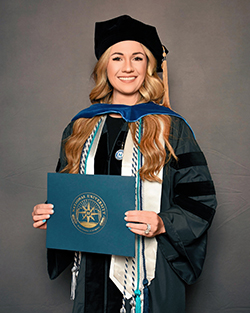
Dr. Bailey Lancaster poses with her degree after her graduation from National University in San Diego, California.
Lancaster earned her Doctor of General Psychology with an emphasis in Performance Psychology from National University in July.
She is also a Northwestern alumna, graduating with a Bachelor of Science in Health and Sports Science Education in 2015 and a Master of Counseling Psychology in 2017.
“This doctoral degree has expanded my ability to connect performance psychology with counselor wellness, particularly in addressing burnout,” Lancaster said. “The mental health crisis in Oklahoma, the U.S. and worldwide demands counselors who are not only clinically skilled but personally resilient. By integrating recovery science and performance research into counselor training, I help graduate students understand that sustainable practice depends on maintaining their own mental and physical health through rest, balance, and boundaries.”
Her dissertation is titled, “Managing Midnight Miles: A Qualitative Descriptive Single-Case Study on Sleep Strategies Among United States Ultra-Marathon Runners.”
This qualitative descriptive single-case study explored how U.S. ultra-marathon runners perceive the role of sleep and sleep insufficiency in their physical, psychological and social well-being.
Fifteen participants completed semi-structured virtual interviews and the findings revealed nine major themes related to how athletes optimize recovery, regulate emotions and maintain performance despite chronic fatigue and life demands.
Guided by the biopsychosocial model, the research demonstrated that high performers - whether athletes, counselors or educators - face similar challenges: balancing recovery, relationships and identity under sustained pressure.
“As a counselor, educator, mother and wife, I’ve seen firsthand how easy it is to neglect rest and recovery in the service of others,” Lancaster said. “My research helped me understand that we can’t pour from an empty cup. Counselors must prioritize boundaries, rest, and recovery to reduce burnout and sustainably support others.”
According to the Centers for Disease Control and Prevention in 2023, nearly one in three adults in the U.S. do not get the sleep they need, a statistic that deeply resonates with those in the helping professions.
“Sleep isn’t just a biological need—it’s an ethical responsibility for those in helping professions,” Lancaster said. “If we want to address the mental health crisis, we must start by ensuring the well-being of the professionals serving others.”
Dr. Christopher Neu
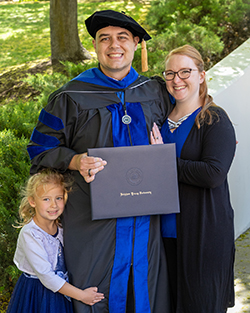
Dr. Christopher Neu and his family pose for a photo at his graduation from Brigham Young University.
Neu graduated with his Doctor of Philosophy in Marriage and Family Therapy from Brigham Young University this December.
He previously earned a Bachelor of Science in Family Studies from Brigham Young in April 2018 and graduated with a Master of Science in Marriage and Family Therapy from the University of Nebraska-Lincoln in December 2021.
“My doctoral degree emphasizes advanced systemic theory, outcome and process research, and statistics, which strengthens my ability to help all of our students at Northwestern see how rigorous inquiry can explain and improve relational and psychological processes,” Neu said. “I want students to engage directly with research by asking meaningful questions, working with data, and connecting findings to everyday problems so they can appreciate how evidence, not opinion, should guide practice and policy.”
His dissertation is titled, “Physiological Activation Patterns of a Neurodiverse Couple in Relational Therapy.”
This four-session clinical study investigated the connection between Attention Deficit/Hyperactivity Disorder (ADHD) status and autonomic responses to negative facial expressions from partners and therapists in couple therapy.
Research on ADHD individuals in romantic relationships suggests significant relational dissatisfaction. Polyvagal theory explains these challenges, and predicts decreased parasympathetic nervous system (PNS) activation and increased sympathetic nervous system (SNS) activation in response to threats. Because ADHD is characterized by emotion dysregulation and rejection sensitivity, relational challenges may stem from elevated SNS and dampened PNS activity.
Using a single-case design, physiologic markers of SNS activity and PNS activity were examined. The findings support that ADHD-related regulatory challenges may interfere with the couple therapy process.
Neu said this degree supports his goal of creating a learning environment where majors in psychology, counseling and related fields become confident, research-informed thinkers who use data and theory to understand people, relationships and systems in ethically responsible ways.
Dr. Heidi Ritchie
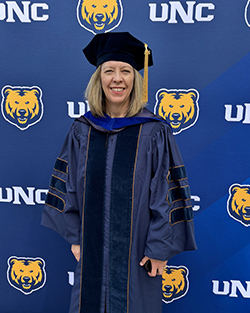
Dr. Heidi Ritchie stops for photo at her graduation from the University of Northern Colorado in Greeley, Colorado.
Ritchie graduated with her Doctor of Philosophy in Nursing Education from the University of Northern Colorado in May.
She previously earned a diploma in Nursing from Bryan Memorial Hospital in Lincoln, Nebraska, in 1996. She then went on to earn a Bachelor of Science in Nursing from Nebraska Wesleyan University in 1998 and a Master of Science with emphasis in Nursing Education from the University of Northern Colorado in 2003.
“As a registered nurse with almost 30 years of clinical experience, I believe it is vital that we continue to improve nursing education,” Ritchie said. “Further research here in Oklahoma is needed to help us understand how to best prepare our nursing students to thrive and continue to be leaders in clinical practice.”
Her dissertation is titled, “Exploration of Disorienting Dilemmas New Registered Nurses Experience in Clinical Situations.”
Eighteen new graduate Registered Nurses from the United States with greater than six months and less than two years of experience were interviewed. By initial and focused coding, five concepts were identified. Based upon these five concepts, a theoretical model was developed to represent the experience new graduate registered nurses described when confronted with a disorienting dilemma.
Findings indicate that disorienting dilemmas were “red stop light” experiences for 13 of these new registered nurses. The disorienting dilemma caused them to stop, assess the situation and then decide how to proceed.
When new graduate Registered Nurses perceived they were able to successfully navigate the disorienting dilemma and resolve the situation, they were able to see it as a growth process. However, some were unable to resolve the disorienting dilemma and left bedside clinical practice, changed from night shift to day shift, moved from full-time to part-time, or refused to work with other registered nurses due to the outcome of the dilemma.
“My goal is to conduct further research studies regarding disorienting dilemmas to examine their impact on all clinical nurses as a means to improve nurse retention at the bedside and improve clinical practice,” Ritchie said. “This research will be used to help bridge the gap between nursing education and practice.”
Ritchie plans to develop tools and simulation experiences to assist nursing students with understanding the dilemmas they may encounter in practice and learn how to successfully navigate them.
Dr. Derek Trabuc
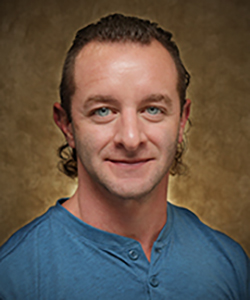
Dr. Derek Trabuc, Northwestern Oklahoma State University instructor of education.
Trabuc graduated with his Doctor of Education in Curriculum and Instruction from the American College of Education in Indianapolis, Indiana, this December.
He holds two degrees from Pittsburg State University in Pittsburg, Kansas, including a Bachelor of Science in Elementary Education, which he received in May 2004, and a Master of Science in Educational Leadership, which he received in December 2009.
His dissertation is titled, “Inclusion of Autistic Students and Educator Preparation: Qualitative Case Study,” a descriptive case study to identify the perceptions of educators when instructing students with autism in the general education classroom.
“This degree helps me provide future teachers with new and practical knowledge to help them be successful in a diverse classroom,” Trabuc said.
Dr. Olivia Yandel
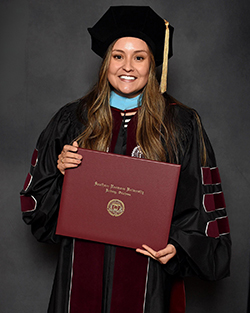
Dr. Olivia Yandel poses with her degree at her graduation from Southern Nazarene University in Bethany on Dec. 6.
Yandel graduated with her Doctor of Education in Administration and Leadership from Southern Nazarene University on Dec. 6.
Yandel is a Northwestern alumna, graduating with a Bachelor of Science in Health and Sports Science in 2014 and a Master’s in Adult Education and Sports Administration in 2016.
Her dissertation is titled, “The Impact of Student Engagement in First-Year College Students: A Case Study.”
The findings from this qualitative case study have highlighted how multidimensional student engagement can be and the role student engagement plays in shaping first-year students’ personal trajectories.
The research identified that student engagement is not a one-size-fits-all approach, and there appears to be a disconnect between students and institutions on what defines student engagement.
Additionally, the findings of this study confirm that social media serves as a primary channel for student engagement information. The participants rely heavily on friends’ invitations and digital platforms as primary ways to decide to participate in events. Institutions can no longer rely solely on traditional communication channels to promote their student engagement opportunities.
However, to effectively foster engagement, universities must strategically utilize digital platforms to meet students where they are. Institutions should intentionally cultivate and utilize positive peer-to-peer influence and construct ways to build a sense of belonging amongst first-year students. A student’s emotional well-being is vital in the first year and student engagement can be greatly impacted by this.
Finally, the importance of student engagement is not merely an outcome, it is a catalyst that propels personal development within first-year students. When universities create a culture of belonging, engagement naturally follows.
“I performed my study at a small, public four-year university and found the findings to be extremely beneficial to the future of student engagement at colleges like Northwestern,” Yandel said. “With the information from this study, universities can better serve the first-year student population by identifying the needs and desires of these students. We can find ways to increase engagement across the board, but also assist with increasing retention rates, thus leading to higher graduation rates from these students.”
The study found the importance of informal support networks, such as the relationships and trust built between students and their peers, faculty and staff, therefore universities have the capability to use this information to cultivate a culture of acceptance and belonging.
“For me, this study was extremely eye-opening to the importance of building camaraderie on our campus,” Yandel said. “As the wellness center director and lecturer, I take for granted the chances to connect with students on a personal level. I hope to be more mindful about reaching out to students and connecting with them, not just on a professional level, but on a personal level as well.”
For more information about Northwestern, visit nwosu.edu.
-NW-
Media Contact:
Sean J. Doherty, University Relations Specialist
Email: sjdoherty@nwosu.edu
Phone: (580) 327-8480